The ribbon is the part of the award a wrestler actually holds. It goes over the head first, carries the weight of the medal against the chest, and shows off your club name or tournament logo long after the bracket is forgotten. Yet most people ordering wrestling medals decide the ribbon last, if they decide it at all. Spending five minutes on it up front gets you a cleaner-looking award and avoids the two most common problems: a heavy medal on a flimsy band, or artwork that disappears behind a fold.
This walkthrough covers how to pair a ribbon to your medal, when to pay for full-color printing, and how attachment style quietly limits where your logo can sit. The numbers below are drawn from published specs at national medal suppliers and are meant as planning figures, not quotes.
Match the ribbon width to the medal
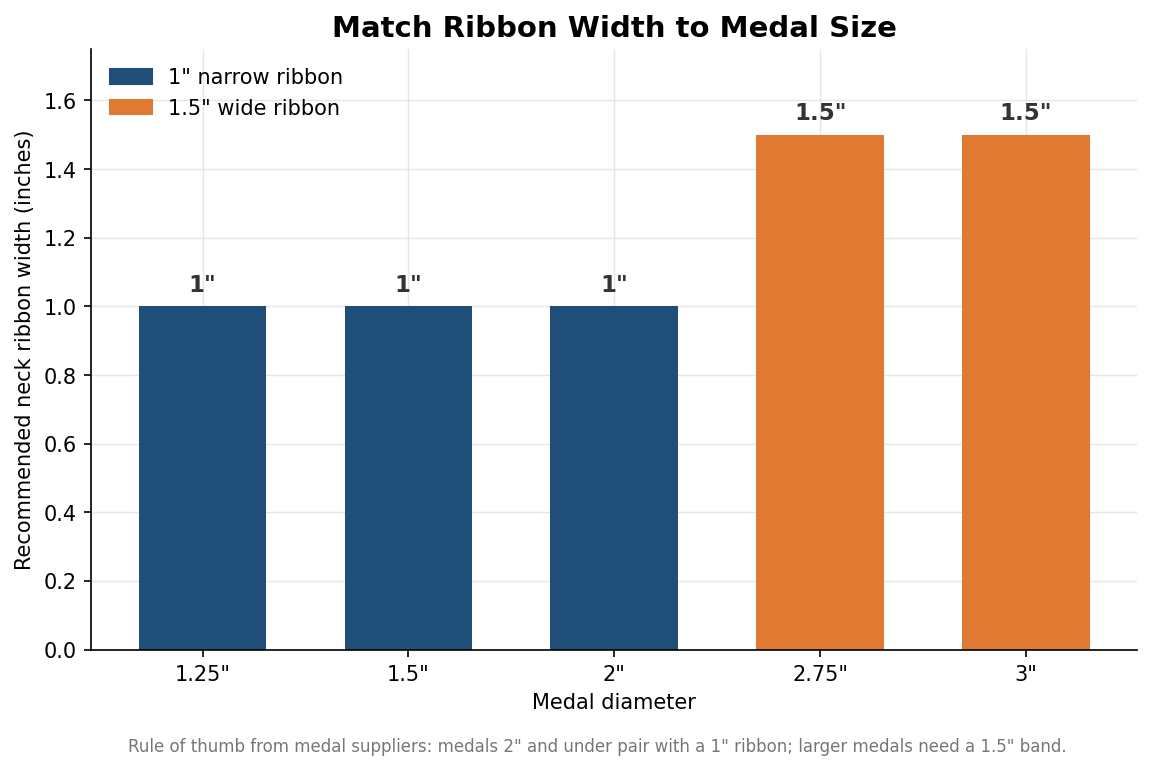
Neck ribbons come in two standard widths: a 1-inch narrow band and a 1.5-inch wide band. The pairing rule most suppliers use is simple. Medals two inches in diameter and smaller look balanced on a 1-inch ribbon; medals larger than two inches want the 1.5-inch band so the ribbon reads as part of the award rather than an afterthought. A three-inch medal hanging from a thin one-inch strap looks bottom-heavy, and the narrow band is more likely to twist as the wrestler moves.
Length is more standardized. Custom neck ribbons typically run 32 to 36 inches in total loop length, which folds to a chest drop of roughly 16 to 18 inches on an adult. For youth events the same 32 to 34 inch loop is usually fine, since the medal simply sits a little lower on a smaller frame. If you are ordering for a wide age range, a 34-inch loop is the safe middle.
Printed versus sublimated ribbons
There are two ways color gets onto a ribbon, and the gap between them is real. Screen-printed ribbons press one or two spot colors onto the band. They handle a club name, a simple mascot, or a year cleanly and cost the least. They struggle with gradients, photos, and precise color matching. Sublimated ribbons dye the design into the fabric, edge to edge, in full color. Sublimation is the choice when you have a sponsor logo, a multicolor crest, or a specific brand color you need to hit, because the process can approximate Pantone (PMS) values and coordinate the ribbon with the medal artwork.
The tradeoff is cost and minimums. Sublimated ribbons run more per unit than screen-printed ones and usually carry a minimum order, so they make more sense once you are buying in the dozens rather than a handful. If your design is a single-color club name, paying for sublimation buys you little. If you are carrying a sponsor’s logo that helped fund the tournament, it is often worth it.
How attachment style limits your artwork
The way the ribbon is sewn into a loop affects where a logo can go. A bar attachment sews the band across a bar, which means you cannot place important artwork at the nape of the neck where the seam sits. A loop (or “V”) attachment sews a V into the front of the ribbon and shifts the usable print area accordingly. Neither is better; they simply move the “dead zone” to a different spot. The practical takeaway is to send your artwork to the supplier before you finalize, and ask them to mark where the seam falls so your logo is not half-swallowed by a fold.
Medal size, finish, and how deep to award
Wrestling medals are commonly offered in 1.25, 1.5, 2, 2.75, and 3-inch diameters, in gold, silver, and bronze finishes. Placement convention is unchanged from the Olympics most kids have seen on TV: gold for first, silver for second, bronze for third. Where youth and club tournaments differ is depth. Folkstyle brackets often place through fourth, sixth, or even eighth, so many organizers order a run of gold-silver-bronze for the podium plus a single neutral “place” finish for the remaining spots. Deciding that depth before you order is what keeps you from a second rush shipment.
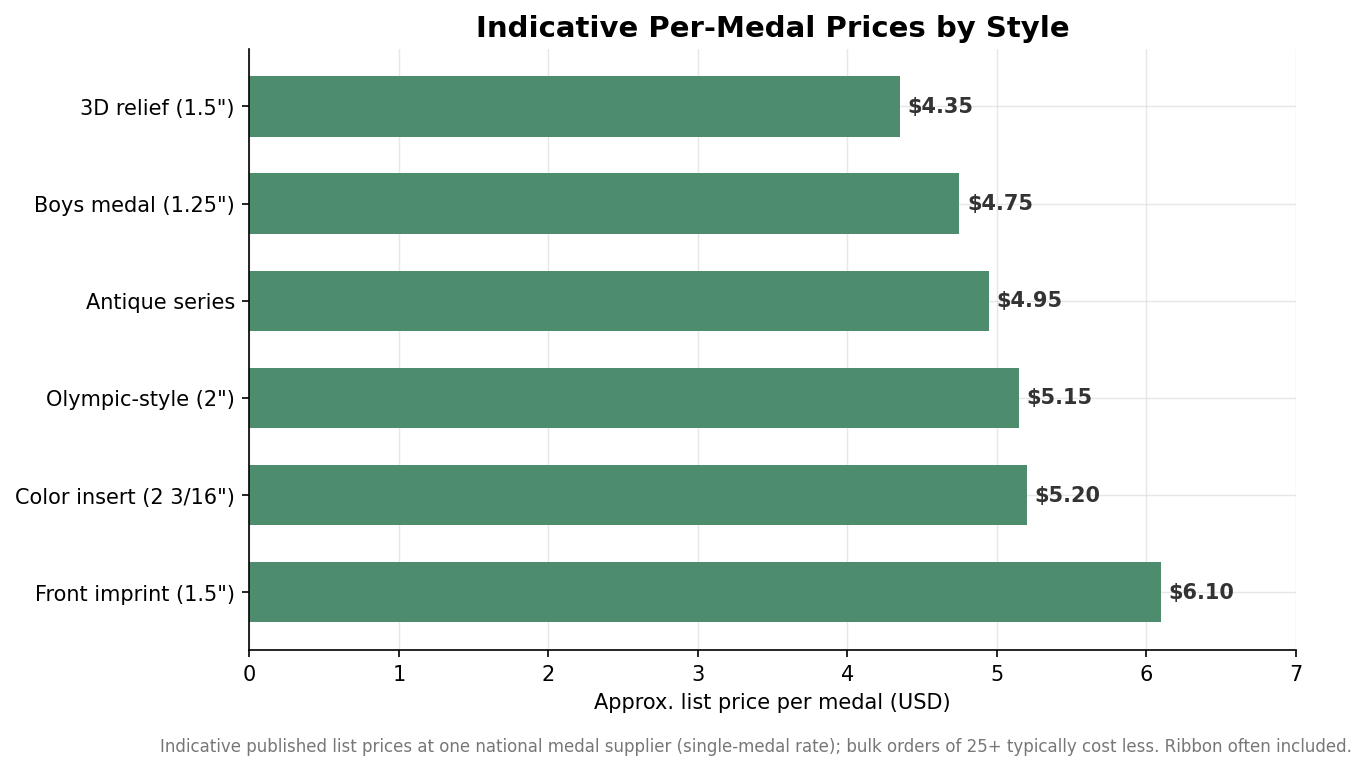
Price tracks construction more than raw size. Indicative single-medal list prices at one national supplier ranged from about $4.35 for a 3D relief medal to $6.10 for a front-imprint style, with most common wrestling medals landing between roughly $4.75 and $5.20 each. Ribbon is frequently included at no extra charge, and bulk pricing generally kicks in at 25 units and up, so the per-medal figure drops as the order grows. Treat the chart below as a shape, not a quote: your exact number depends on finish, engraving, and quantity.
Putting a full spec together
Here is how the pieces fit for a typical eight-team youth folkstyle tournament placing through fourth. You might order 2-inch medals, which keeps you on the 1-inch ribbon and holds cost down; a screen-printed band if the design is just the club name and year, or sublimated if a sponsor logo is involved; a 34-inch loop length to cover the age spread; and a gold-silver-bronze podium set plus a single “place” finish for fourth. With medals in the $5 range before bulk pricing, and ribbon included, a mid-size event’s award budget becomes easy to estimate weeks ahead rather than the night before weigh-ins.
None of these choices is expensive on its own, but getting them wrong means a reorder or an award that photographs poorly. Decide the medal size first, let it pick your ribbon width, choose printed or sublimated based on whether real color matters, and confirm the seam placement against your logo. Do that and the ribbon stops being an afterthought and starts doing its job.