Order too few medals and you are apologizing to a sixth-place finisher and their parents on the day. Order wildly too many and you have paid for a box that sits in a closet until next season, minus the ones that no longer match because you tweaked the design. Getting the count right is not guesswork. It comes down to three numbers you already control: how many weight classes you run, how many places you award, and how many separate divisions compete. Multiply, add a small cushion, and order. Here is how to do that cleanly.
Start with the placement policy
Decide how deep you award before anything else, because it drives everything downstream. A wrestling bracket with a full consolation round can place wrestlers well beyond the podium. A 16-wrestler bracket with wrestlebacks typically determines first through eighth place, which is why larger and higher-stakes tournaments often medal the top 8. Smaller round-robin or 8-person brackets usually settle cleanly at top 4 or top 6, and many youth events medal the top 4 to keep costs down and the line at the award table short. There is no universal rule here; state associations and tournament directors set it. Pick the depth deliberately, publish it, and size the order to it.
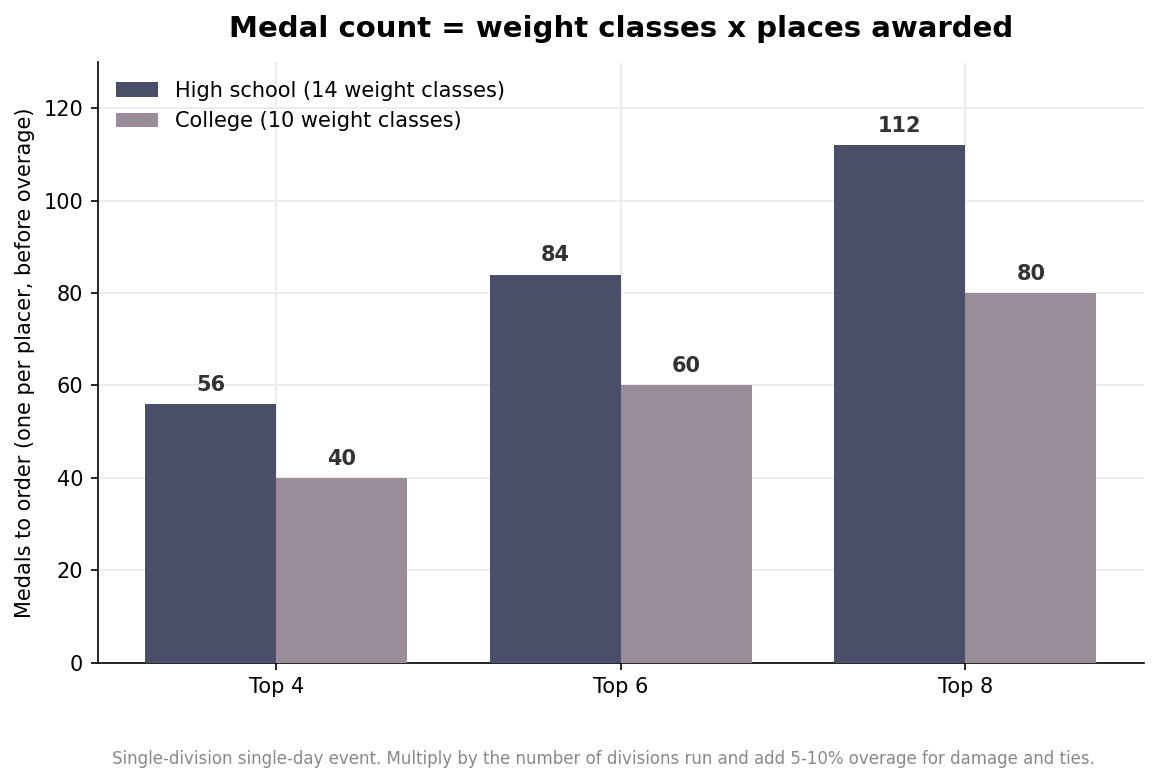
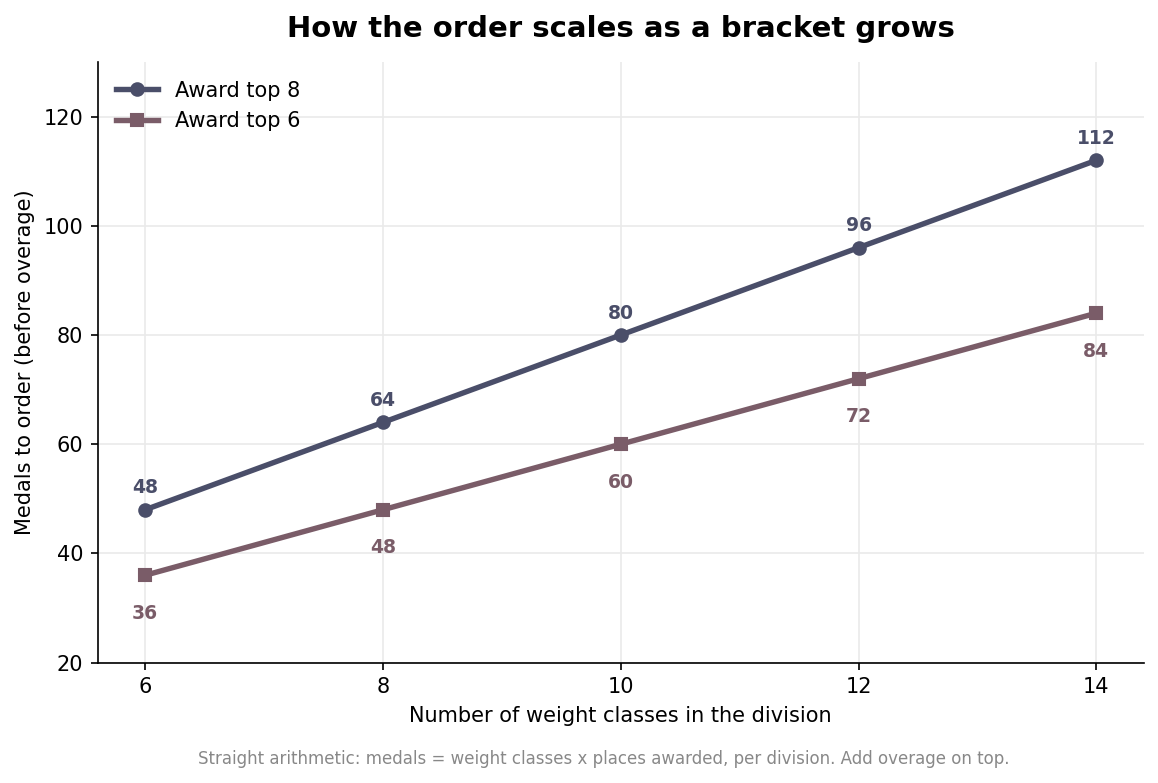
The arithmetic from there is simple. Medals for one division equal the number of weight classes times the number of places you award. Award the top 6 across a 14-class high school bracket and you need 84 medals; go to the top 8 and it is 112. Run a college-style 10-class bracket and the same policies produce 60 and 80. Those are your base numbers before anything else touches them.
Count your weight classes honestly
The weight-class count is not a single fixed number anymore, so use the one that matches the event you are actually running. Since the 2023-24 season, high school associations choose among 12, 13, or 14 weight classes for both boys and girls, so a state running the full 14 has more brackets to award than a neighbor that adopted 12. The standard 14-class boys lineup runs 106, 113, 120, 126, 132, 138, 144, 150, 157, 165, 175, 190, 215, and 285 pounds. Girls’ 14-class competition uses its own separate figures, and college tightens the field to 10 weight classes at 125 through 285. Youth folkstyle events frequently skip fixed charts altogether and bracket kids on the day by weighing everyone in and grouping the nearest eight or sixteen, which means you may not know the exact bracket count until the morning of the event.
That last case is the one that catches directors out. If your youth tournament brackets on the day, you cannot count classes in advance, so estimate from last year’s entries per age and weight band, then lean toward a slightly generous order because you would rather carry a few extra than come up short mid-tournament.
Multiply by divisions, then add overage
A single number for one bracket is rarely the whole order. If you run separate divisions on the same day, boys and girls, or several age groups in a youth event, each division is its own multiplication and the totals add up fast. Two divisions each awarding the top 8 across 14 classes is 224 medals, not 112. Map out every division you are actually running and sum them rather than eyeballing a round number.
On top of the base total, add a modest overage of roughly 5 to 10 percent. That cushion covers medals damaged in shipping, the occasional tie that awards two of the same place, a bracket that unexpectedly fills, and a couple of replacements for pieces that arrive flawed. Overage is cheap insurance; running out is not. What you should not do is dramatically overbuy year to year, because custom medals are tied to a specific design, and any change to the plate art, the year stamped on it, or the sport figure can leave last season’s surplus unusable.
Order early and lock the design
Custom medals are made to order, and the timeline is unforgiving if you wait. Production commonly runs about three weeks from art approval, and that clock does not start until you have signed off on the proof, which itself takes a round or two of back-and-forth. Build in time for shipping after that, and remember that the busy season compresses everyone’s lead times. A safe habit is to finalize the design and place the order four to six weeks before the event, not the week of.
A few specification choices affect both cost and how the order reads at the podium. Custom medals are widely offered in 2 to 3 inch diameters, with 2.75 inches a common middle ground, and a neck ribbon is typically included, often around a 33.5-inch length in a 25-millimeter width. Add-ons such as color fill, back engraving, and premium platings each add a small amount per piece, so decide which ones you actually want before you price the run. Per-piece pricing swings widely with size, plating, and quantity, generally landing in a low single-digit dollar range for standard custom medals, which is another reason to settle the placement depth first: every extra place you award multiplies straight through to the invoice.
Put together, the method is dull in the best way. Choose your placement depth, count the weight classes for the specific event, multiply, repeat for each division, add 5 to 10 percent, and order four to six weeks out on a locked design. Do that and the award table takes care of itself, with a medal for every placer and only a small, sensible handful left over.
Win Free Stuff
Enter below for a chance to win plus receive 10% off your first order.
🎉 You are in!
Check your email for your 10% off code. Good luck!