Category: Uncategorized

  • Wrestling Medal Ribbons: How to Choose Width, Length, and Finish

    Wrestling Medal Ribbons: How to Choose Width, Length, and Finish

    The ribbon is the part of the award a wrestler actually holds. It goes over the head first, carries the weight of the medal against the chest, and shows off your club name or tournament logo long after the bracket is forgotten. Yet most people ordering wrestling medals decide the ribbon last, if they decide it at all. Spending five minutes on it up front gets you a cleaner-looking award and avoids the two most common problems: a heavy medal on a flimsy band, or artwork that disappears behind a fold.

    This walkthrough covers how to pair a ribbon to your medal, when to pay for full-color printing, and how attachment style quietly limits where your logo can sit. The numbers below are drawn from published specs at national medal suppliers and are meant as planning figures, not quotes.

    Match the ribbon width to the medal

    Neck ribbons come in two standard widths: a 1-inch narrow band and a 1.5-inch wide band. The pairing rule most suppliers use is simple. Medals two inches in diameter and smaller look balanced on a 1-inch ribbon; medals larger than two inches want the 1.5-inch band so the ribbon reads as part of the award rather than an afterthought. A three-inch medal hanging from a thin one-inch strap looks bottom-heavy, and the narrow band is more likely to twist as the wrestler moves.

    Length is more standardized. Custom neck ribbons typically run 32 to 36 inches in total loop length, which folds to a chest drop of roughly 16 to 18 inches on an adult. For youth events the same 32 to 34 inch loop is usually fine, since the medal simply sits a little lower on a smaller frame. If you are ordering for a wide age range, a 34-inch loop is the safe middle.
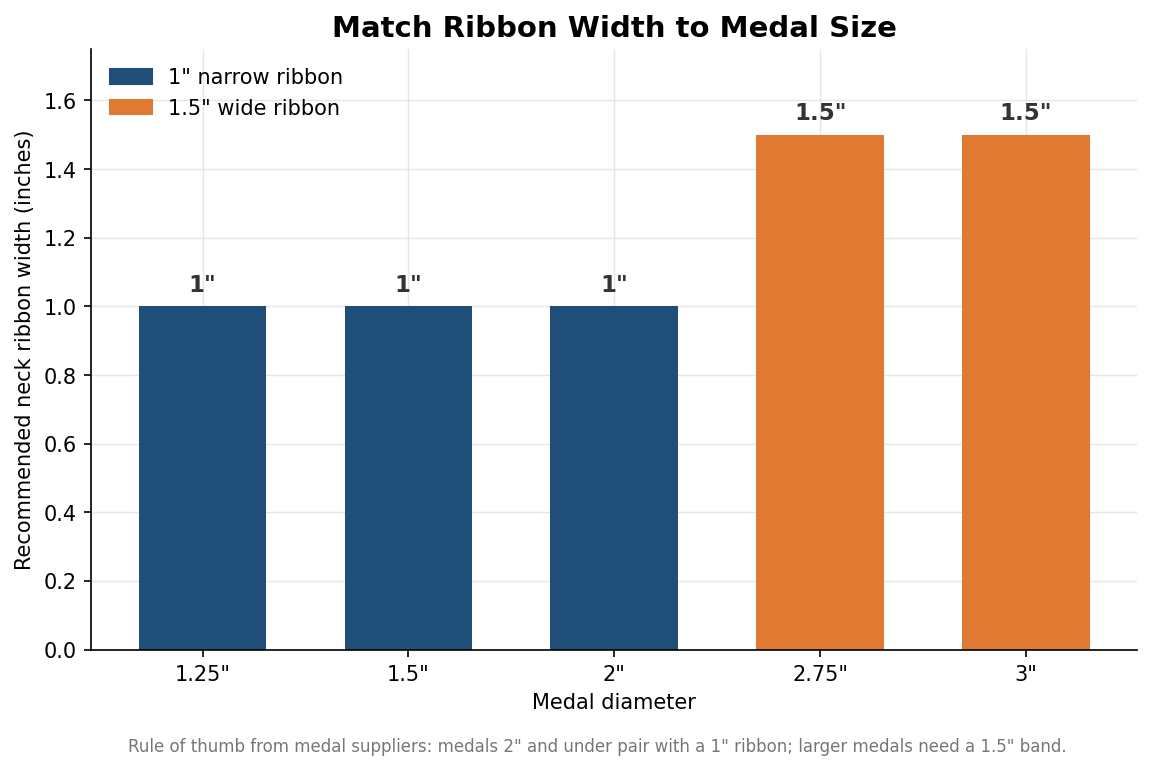
    Bar chart showing recommended neck ribbon width by wrestling medal diameter
    Medals 2 inches and under pair with a 1-inch ribbon; larger medals take the 1.5-inch band.

    Printed versus sublimated ribbons

    There are two ways color gets onto a ribbon, and the gap between them is real. Screen-printed ribbons press one or two spot colors onto the band. They handle a club name, a simple mascot, or a year cleanly and cost the least. They struggle with gradients, photos, and precise color matching. Sublimated ribbons dye the design into the fabric, edge to edge, in full color. Sublimation is the choice when you have a sponsor logo, a multicolor crest, or a specific brand color you need to hit, because the process can approximate Pantone (PMS) values and coordinate the ribbon with the medal artwork.

    The tradeoff is cost and minimums. Sublimated ribbons run more per unit than screen-printed ones and usually carry a minimum order, so they make more sense once you are buying in the dozens rather than a handful. If your design is a single-color club name, paying for sublimation buys you little. If you are carrying a sponsor’s logo that helped fund the tournament, it is often worth it.

    How attachment style limits your artwork

    The way the ribbon is sewn into a loop affects where a logo can go. A bar attachment sews the band across a bar, which means you cannot place important artwork at the nape of the neck where the seam sits. A loop (or “V”) attachment sews a V into the front of the ribbon and shifts the usable print area accordingly. Neither is better; they simply move the “dead zone” to a different spot. The practical takeaway is to send your artwork to the supplier before you finalize, and ask them to mark where the seam falls so your logo is not half-swallowed by a fold.

    Medal size, finish, and how deep to award

    Wrestling medals are commonly offered in 1.25, 1.5, 2, 2.75, and 3-inch diameters, in gold, silver, and bronze finishes. Placement convention is unchanged from the Olympics most kids have seen on TV: gold for first, silver for second, bronze for third. Where youth and club tournaments differ is depth. Folkstyle brackets often place through fourth, sixth, or even eighth, so many organizers order a run of gold-silver-bronze for the podium plus a single neutral “place” finish for the remaining spots. Deciding that depth before you order is what keeps you from a second rush shipment.

    Price tracks construction more than raw size. Indicative single-medal list prices at one national supplier ranged from about $4.35 for a 3D relief medal to $6.10 for a front-imprint style, with most common wrestling medals landing between roughly $4.75 and $5.20 each. Ribbon is frequently included at no extra charge, and bulk pricing generally kicks in at 25 units and up, so the per-medal figure drops as the order grows. Treat the chart below as a shape, not a quote: your exact number depends on finish, engraving, and quantity.
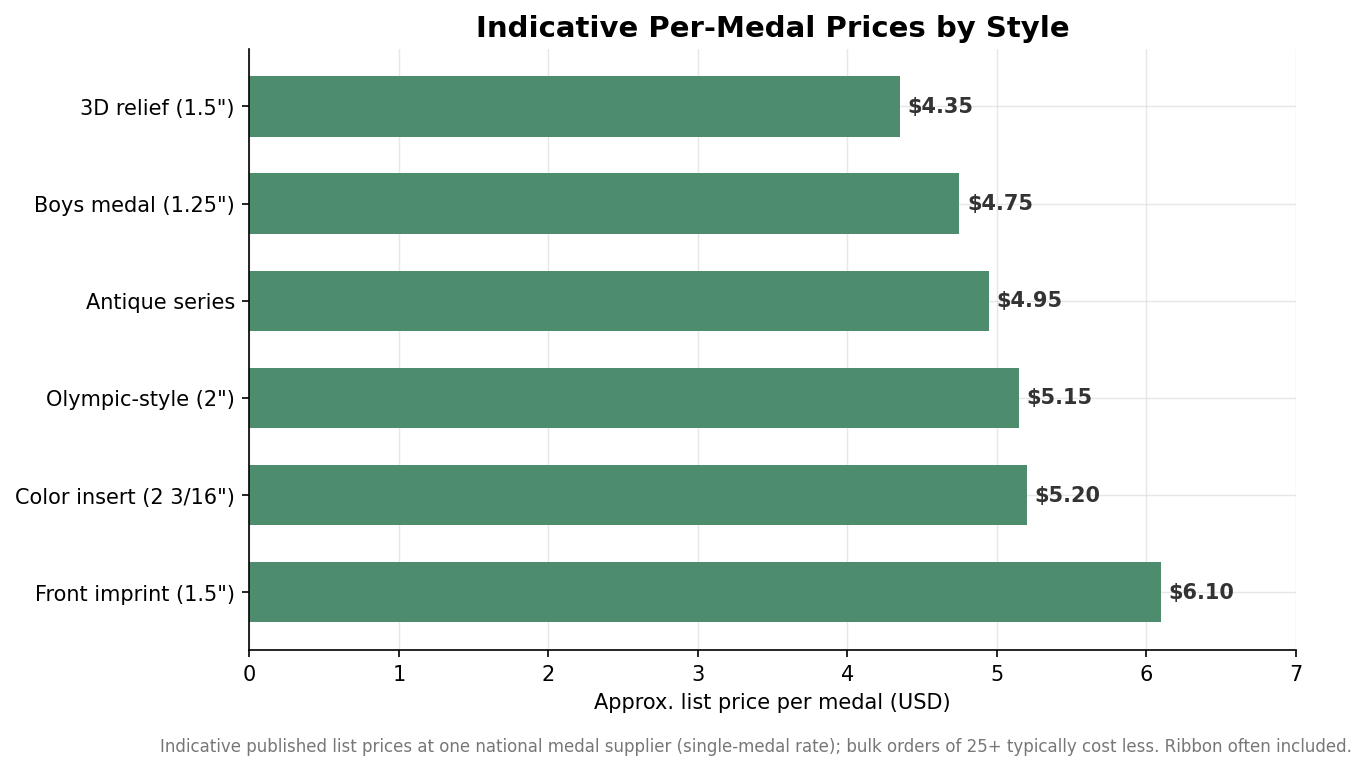
    Horizontal bar chart of indicative per-medal list prices across common wrestling medal styles
    Indicative single-medal list prices at one national supplier; bulk orders of 25+ typically cost less.

    Putting a full spec together

    Here is how the pieces fit for a typical eight-team youth folkstyle tournament placing through fourth. You might order 2-inch medals, which keeps you on the 1-inch ribbon and holds cost down; a screen-printed band if the design is just the club name and year, or sublimated if a sponsor logo is involved; a 34-inch loop length to cover the age spread; and a gold-silver-bronze podium set plus a single “place” finish for fourth. With medals in the $5 range before bulk pricing, and ribbon included, a mid-size event’s award budget becomes easy to estimate weeks ahead rather than the night before weigh-ins.

    None of these choices is expensive on its own, but getting them wrong means a reorder or an award that photographs poorly. Decide the medal size first, let it pick your ribbon width, choose printed or sublimated based on whether real color matters, and confirm the seam placement against your logo. Do that and the ribbon stops being an afterthought and starts doing its job.
  • How Many Wrestling Medals to Order for a Tournament

    How Many Wrestling Medals to Order for a Tournament

    Order too few medals and you are apologizing to a sixth-place finisher and their parents on the day. Order wildly too many and you have paid for a box that sits in a closet until next season, minus the ones that no longer match because you tweaked the design. Getting the count right is not guesswork. It comes down to three numbers you already control: how many weight classes you run, how many places you award, and how many separate divisions compete. Multiply, add a small cushion, and order. Here is how to do that cleanly.

    Start with the placement policy

    Decide how deep you award before anything else, because it drives everything downstream. A wrestling bracket with a full consolation round can place wrestlers well beyond the podium. A 16-wrestler bracket with wrestlebacks typically determines first through eighth place, which is why larger and higher-stakes tournaments often medal the top 8. Smaller round-robin or 8-person brackets usually settle cleanly at top 4 or top 6, and many youth events medal the top 4 to keep costs down and the line at the award table short. There is no universal rule here; state associations and tournament directors set it. Pick the depth deliberately, publish it, and size the order to it.

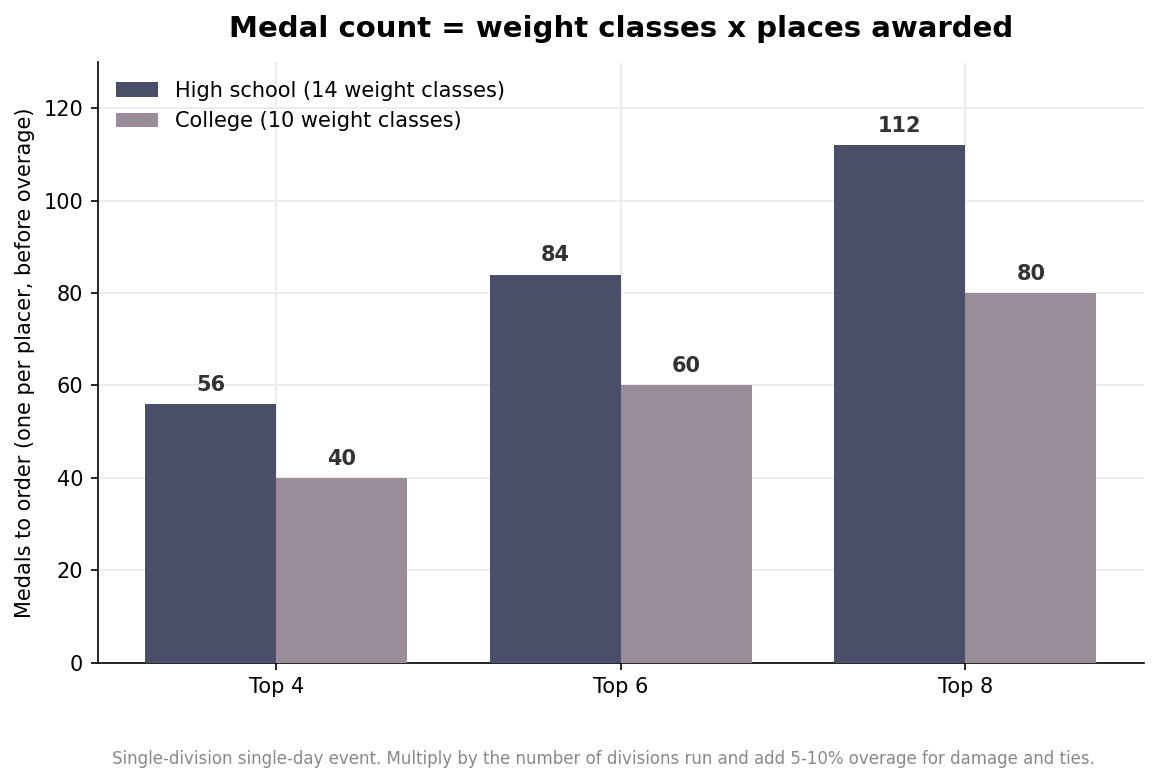
    The arithmetic from there is simple. Medals for one division equal the number of weight classes times the number of places you award. Award the top 6 across a 14-class high school bracket and you need 84 medals; go to the top 8 and it is 112. Run a college-style 10-class bracket and the same policies produce 60 and 80. Those are your base numbers before anything else touches them.

    Grouped bar chart showing medals to order for high school (14 weight classes) versus college (10 weight classes) at Top 4, Top 6, and Top 8 placement policies
    The base order is simply weight classes multiplied by the number of places you award.

    Count your weight classes honestly

    The weight-class count is not a single fixed number anymore, so use the one that matches the event you are actually running. Since the 2023-24 season, high school associations choose among 12, 13, or 14 weight classes for both boys and girls, so a state running the full 14 has more brackets to award than a neighbor that adopted 12. The standard 14-class boys lineup runs 106, 113, 120, 126, 132, 138, 144, 150, 157, 165, 175, 190, 215, and 285 pounds. Girls’ 14-class competition uses its own separate figures, and college tightens the field to 10 weight classes at 125 through 285. Youth folkstyle events frequently skip fixed charts altogether and bracket kids on the day by weighing everyone in and grouping the nearest eight or sixteen, which means you may not know the exact bracket count until the morning of the event.

    That last case is the one that catches directors out. If your youth tournament brackets on the day, you cannot count classes in advance, so estimate from last year’s entries per age and weight band, then lean toward a slightly generous order because you would rather carry a few extra than come up short mid-tournament.

    Multiply by divisions, then add overage

    A single number for one bracket is rarely the whole order. If you run separate divisions on the same day, boys and girls, or several age groups in a youth event, each division is its own multiplication and the totals add up fast. Two divisions each awarding the top 8 across 14 classes is 224 medals, not 112. Map out every division you are actually running and sum them rather than eyeballing a round number.

    On top of the base total, add a modest overage of roughly 5 to 10 percent. That cushion covers medals damaged in shipping, the occasional tie that awards two of the same place, a bracket that unexpectedly fills, and a couple of replacements for pieces that arrive flawed. Overage is cheap insurance; running out is not. What you should not do is dramatically overbuy year to year, because custom medals are tied to a specific design, and any change to the plate art, the year stamped on it, or the sport figure can leave last season’s surplus unusable.

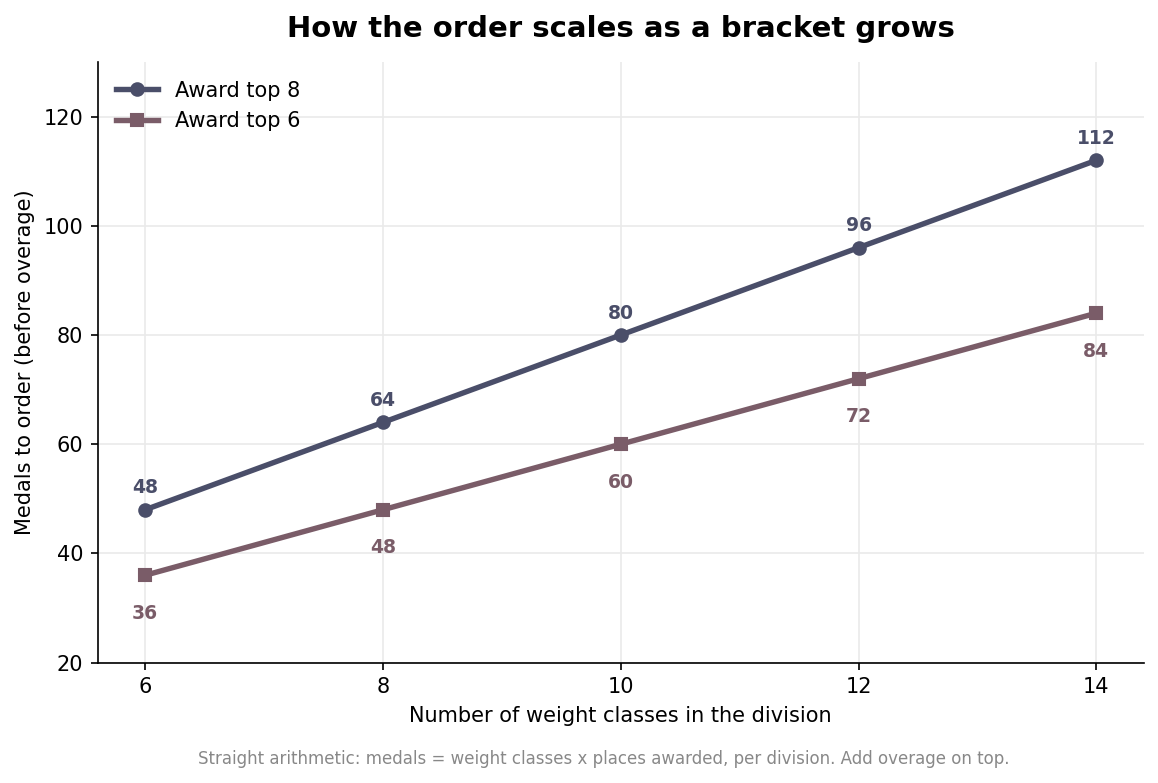
    Line chart showing total medals needed rising with the number of weight classes, for top-6 and top-8 award structures
    Medal counts climb linearly with bracket size; deeper placement adds a second, higher line.

    Order early and lock the design

    Custom medals are made to order, and the timeline is unforgiving if you wait. Production commonly runs about three weeks from art approval, and that clock does not start until you have signed off on the proof, which itself takes a round or two of back-and-forth. Build in time for shipping after that, and remember that the busy season compresses everyone’s lead times. A safe habit is to finalize the design and place the order four to six weeks before the event, not the week of.

    A few specification choices affect both cost and how the order reads at the podium. Custom medals are widely offered in 2 to 3 inch diameters, with 2.75 inches a common middle ground, and a neck ribbon is typically included, often around a 33.5-inch length in a 25-millimeter width. Add-ons such as color fill, back engraving, and premium platings each add a small amount per piece, so decide which ones you actually want before you price the run. Per-piece pricing swings widely with size, plating, and quantity, generally landing in a low single-digit dollar range for standard custom medals, which is another reason to settle the placement depth first: every extra place you award multiplies straight through to the invoice.

    Put together, the method is dull in the best way. Choose your placement depth, count the weight classes for the specific event, multiply, repeat for each division, add 5 to 10 percent, and order four to six weeks out on a locked design. Do that and the award table takes care of itself, with a medal for every placer and only a small, sensible handful left over.

  • Die-Cast vs Insert Medals: Where the Money Actually Goes

    Call or Text us: (929) 605-4397
    Specs

    Die-Cast vs Insert Medals: Where the Money Actually Goes

    Two constructions, two cost curves

    A die-cast medal strikes your design into metal from a custom mold. An insert medal prints your design and sets it into a ready-made frame. The mold is the difference: die-cast pays for tooling once and then gets cheap per unit; inserts skip tooling entirely.

    When die-cast wins

    One design, real quantity, a look with depth. Placement sets for a whole tournament in gold, silver and bronze plate from a single mold, and the mold is kept for reorders — next season’s run gets cheaper, not pricier.

    When inserts win

    Changing artwork, tight timelines and full-color logos. A club running monthly events can keep one frame and print a new insert every event. Gradient artwork and mascots reproduce exactly, dome-sealed against gym-bag wear.

    The hybrid most programs land on

    Die-cast for the season’s championship, inserts for the weekly and dual meets. The championship keeps its weight; the schedule keeps its budget.

    Pricing either one

    Send the design and the bracket math and we quote both routes on your mockup. Minimum order is 12 medals, the mockup is free within 24 hours, and production runs 2 weeks.

    Create your custom wrestling medals now.

    Send your logo, quantity and date — you’ll get a free mockup and quote within one business day.

    Get a Quote
    GET A QUOTE
  • How Award Tables Build Wrestling Programs

    Call or Text us: (929) 605-4397
    Business

    How Award Tables Build Wrestling Programs

    The retention problem nobody budgets for

    Retention is the quiet crisis of youth wrestling: kids who lose early quit early. The programs that keep kids on the mat treat recognition as infrastructure, not decoration — and the award table is where that shows.

    A medal is proof of progress

    A seven-year-old cannot see their own improvement, but they can hold it. Most-improved, first-takedown, iron-man awards — medals for the process, not just the podium — give every wrestler in the room evidence that showing up works.

    Collections create traditions

    When a club’s medal has a signature look — a shape, a ribbon, a series design that evolves each year — kids start collecting them, and collecting them means coming back. The medal case at home becomes the retention program.

    Parents photograph what you hand out

    Every award ceremony ends up on family social feeds, and the medal is in every frame. A distinctive medal with the club’s name legible is the cheapest advertising a program will ever run, aimed exactly at the families most likely to join.

    Build the table for the season

    Order the placement sets, the process awards and the championship medals in one plan and the per-medal price drops with the volume. Send your logo and season schedule — free mockup within 24 hours, minimum order 12 medals, production in 2 weeks.

    Create your custom wrestling medals now.

    Send your logo, quantity and date — you’ll get a free mockup and quote within one business day.

    Get a Quote
    GET A QUOTE
  • Custom Wrestling Medals: A Buyer’s Guide

    Call or Text us: (929) 605-4397
    Buyer’s guide

    Custom Wrestling Medals: A Buyer’s Guide

    The medal outlives the tournament

    A tournament is remembered by two things: how the brackets ran and what the kids took home. One of those you can lock in two weeks ahead. The medal on the shelf is the advertisement for next year’s entry fee, which is why the good events treat it as a product, not an afterthought.

    Match the style to the event

    Die-cast is the standard for placement sets. Inserts stretch a budget and carry full-color art. Custom shapes and 3D sculpting are identity plays for qualifiers and finals. Spinners win youth gyms. If the event is annual, pick a style you can repeat — the collection is the point.

    Order by bracket math, not headcount

    Medals are ordered per placement, per weight class, per division. Count brackets, multiply by places awarded, add a spare set per division for ties and errors. Running out at the awards table is the one mistake parents remember.

    The ribbon is half the medal

    Podium photos show more ribbon than medal. A woven ribbon with the event name turns every photo into branding; a plain red-white-and-blue stock ribbon says the medal came from a catalog.

    What to expect when you order

    Send your logo and your bracket counts. You will get a free mockup within 24 hours, unlimited free revisions, and you pay nothing until you approve it. Minimum order is 12 medals and production runs 2 weeks, with faster turnaround available on express shipping.

    Create your custom wrestling medals now.

    Send your logo, quantity and date — you’ll get a free mockup and quote within one business day.

    Get a Quote
    GET A QUOTE